
Closing Line Value Explained: The Number That Tells You If Your Betting Actually Works
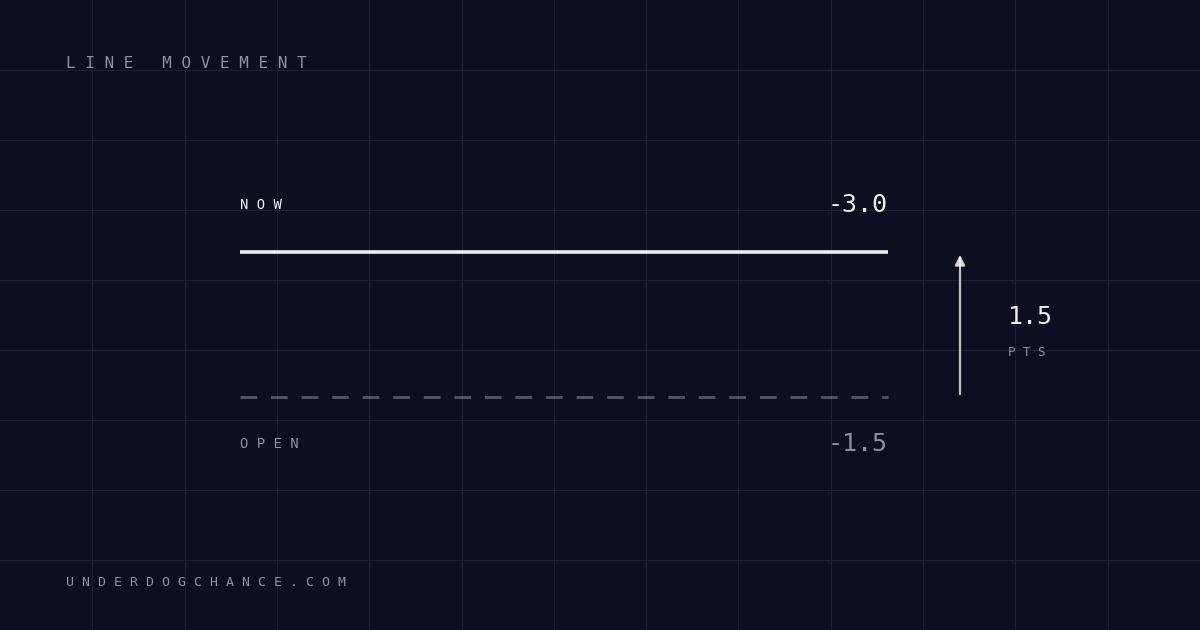
Closing line value is the difference between the price you took and the price the market settled on right before kickoff. If you regularly beat the closing number, you are regularly finding value, and that predicts long-term results better than your win rate does.
That sounds backwards, so sit with it for a second. You can lose a bet and still have made a good bet, if the price you took was clearly better than where the market ended up. You can win a bet and still have made a bad one, if you took a price much worse than the close. Closing line value measures the decision. The result measures one roll of the dice.
How do you calculate closing line value?
Turn both prices into implied probability, then compare them.
Say you took a team at +150 and the game closed at +120.
- +150 implies 100 / (150 + 100) = 40.0%
- +120 implies 100 / (120 + 100) = 45.5%
You got a price that implied 40% on something the market ended up pricing at 45.5%. That 5.5 percentage point gap is your closing line value on that bet.
The two formulas, for American odds:
- Positive odds: 100 / (odds + 100)
- Negative odds: odds / (odds + 100), using the number without the minus sign
Do this for every bet, average it over time, and you have a measure of whether your process finds real edges or just gets lucky sometimes.
Why does this beat tracking your win rate?
Because win rate needs a sample most bettors will never reach in a useful timeframe.
A 55% win rate over 20 bets tells you nothing. It could be skill and it could be a hot month. A 55% win rate over 2,000 bets is meaningful, but by the time you place 2,000 bets you have spent years, and probably a lot of money, finding out something you needed to know at bet 50.
Closing line value shows up much faster, because it does not depend on who won. It depends on whether the market moved toward your number after you bet. Closing lines are the sharpest price a game ever has. They carry the most information and the most money. Beating that number consistently means you saw something before the market finished pricing it.
What does a real closing line value number look like?
Across my own NFL model bets, measured bet by bet against Pinnacle's closing line, closing line value came out at +3.81% across one full season and +4.25% on the 2025/26 snapshot. The same model's raw record over five seasons is 146-112, or 56.59%.
Two honest notes about those numbers, because they matter more than the numbers themselves.
First, the closing line value figure is the one I trust. The win rate is the one people ask about, and it is the weaker of the two, because 258 bets is still a modest sample for a win rate.
Second, beating the close by around 4% is a real result, but it is not what the strongest quantitative bettors in the market do. They work in far tighter margins on far bigger volume. Knowing where you actually sit on that scale is worth more to you than any single win rate claim, because it tells you how much to stake and how much to expect.
That is the point of tracking it. Not to produce a number for marketing, but to know whether the thing you are doing works before the results arrive.
Can you have positive closing line value and still lose money?
Yes, over shorter runs, and this is where most people quit.
Individual game results vary enormously. A correctly priced favourite still loses plenty of times. If you are consistently beating the close, the results follow eventually, but "eventually" needs both volume and a bankroll that survives the wait. A good process with bad stake sizing still goes broke.
What counts as a good closing line value?
Anything consistently positive is meaningful. Beating the close by a few percent on average, across a real sample, puts you ahead of the large majority of bettors. Beating it by more than that consistently is rare.
Consistency matters far more than the size. One bet with 10% closing line value means nothing. An average of 1.5% across 500 bets means a great deal.
How do you start tracking it?
Three habits. None of them need software beyond a spreadsheet.
Log the price when you bet it. Book, market, odds, timestamp. At the moment you bet, not from memory later.
Log the closing price for the same market. Most books show line history, and odds comparison screens show it for free a few minutes before kickoff.
Convert both to implied probability and record the difference. Every bet, including the ones you would rather forget. Selective logging is the fastest way to convince yourself you have an edge you do not have.
The spreadsheet models do this conversion automatically for every bet you log, which is mostly about removing the excuse not to do it.
FAQ
Is closing line value the same as expected value?
No, but they are connected. Expected value is your estimate of a bet's worth before the game. Closing line value checks, afterwards, whether the market agreed with you by the time it closed. Consistently positive closing line value is evidence your expected value estimates are actually accurate.
Which closing line should I measure against?
Use the sharpest book you can access as the reference, not the book you happened to bet at. A sharp book's closing number is the closest thing to a true price the market produces.
Does this work for totals and player props?
It works anywhere there is a liquid closing price. Totals are fine. Player props are thinner, so the closing number is less reliable as a benchmark, though still better than nothing.
What if I bet early, before most of the movement?
Betting early often means taking a price before the market has absorbed all the information. That can produce excellent closing line value when your read is right, and poor closing line value when the information that arrives later goes against you. Either way the number tells you which it was.
How many bets before I trust my average?
Under 100 bets, treat it as noise. Between 300 and 500 you have something worth acting on.
Can beginners use this?
Yes. It is two formulas and one spreadsheet column. The hard part is logging every bet honestly, not the maths.
This is the metric behind everything on this site. If you want to see what causes those closing numbers to move in the first place, read NFL Line Movement Explained. To work through the maths by hand instead of reading about it, the interactive tools let you play with the numbers directly.
Where to start if you want your own number
Closing line value only means something once you have a number of your own to compare against the market. Without that, there is nothing to measure.
That is what The Ultimate Modern Bettor's Toolkit is for. $27, one payment, and it covers building your first model in a spreadsheet, the four-bucket staking system, and the thinking behind both. 30-day money-back guarantee.
MB built Underdog Chance around one idea: make your own number first, then bet only when the price beats it. Over the last 20+ years his simple, probability-based Google Sheets models have helped thousands of bettors stop following picks and start pricing bets for themselves.
Last updated: 19 September 2026