
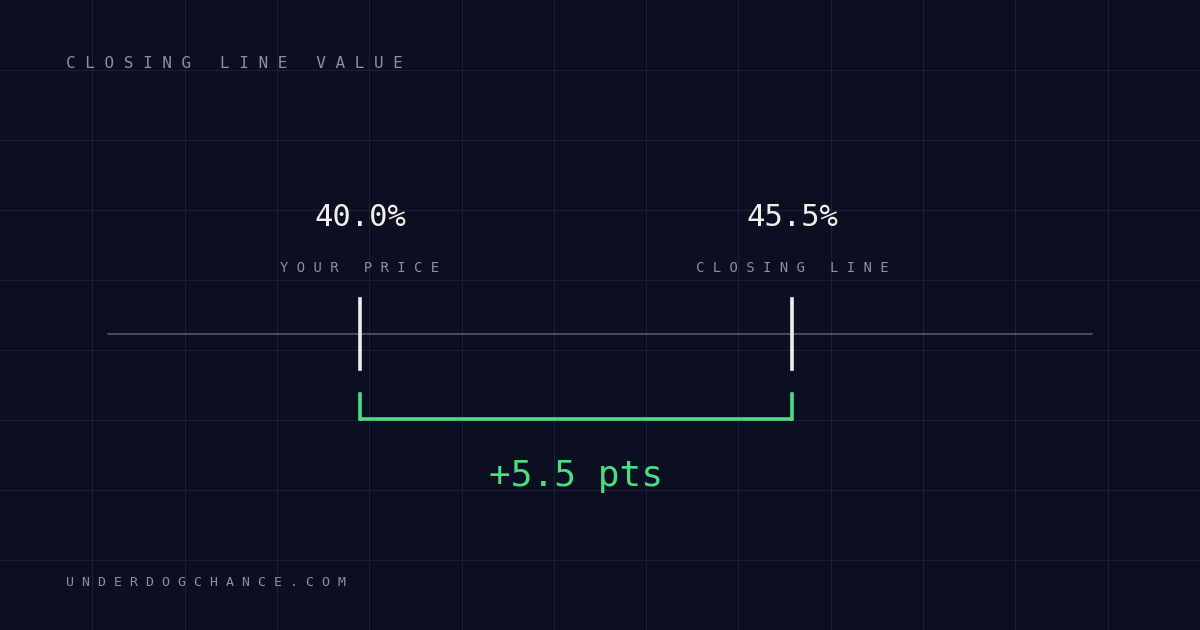
When a betting line moves, it is not random and it is not the sportsbook guessing. It is the market updating its price, and the direction it moves in tells you whether money or information caused it. Learn to read that difference and you are doing something most bettors staring at the same screen never do.
Here is the short version: a line moves because the book needs to balance money, or because a fact changed. Those two causes look identical on the screen and mean completely different things.
The first edge I ever had was a line that moved too slowly
Before online odds screens were everywhere, I bet at a local shop. The shop set its numbers once and was slow to change them. The sharp books online moved within minutes of real news.
So I stopped trying to predict games. I just compared the two. When the local number was better than the sharp number, I bet it. When it was not, I did nothing.
That was the whole system, and it worked until the shop started refusing my bets. The lesson stuck: the money was never in knowing who would win. It was in the gap between a slow price and a fast one.
Line movement is that same gap, visible in real time. Today the slow price and the fast price are usually two tabs in your browser instead of a shop across town.
What actually makes a line move?
Two things. Money and information.
Money movement happens when one side takes more volume than the book wants to carry. Sportsbooks are not trying to predict the game. They are trying to balance their exposure so they collect the margin whichever way it lands. If too much money lands on one side, the book shortens that price to slow it down and makes the other side more attractive.
Information movement happens when something changes the real probability of the outcome. A starting quarterback is ruled out. The weather forecast turns. A key lineman lands on the injury report. This has nothing to do with public opinion and everything to do with a fact changing.
Most bettors treat every move as the second kind. Most moves are the first kind.
How do you tell sharp money from public money?
Compare two numbers that most odds screens show side by side: the percentage of bets on each side, and the percentage of money on each side.
When a game shows 70% of bets on the favourite but the line moves toward the underdog, that is the signal. It means a small number of large bets on the underdog outweighed a large number of small bets on the favourite. Books move on the money, not on the ticket count, because large disciplined bettors are right more often than the crowd.
When bet percentage and money percentage point the same way, the move is mostly the public confirming itself. That tells you much less.
This is the one comparison worth building a habit around. You do not need a paid data service for it.
Does line movement predict who wins?
No, and this is where it gets misused.
A line moving from -1.5 to -3 does not mean that team became more likely to win by a lot. It means enough money believed -1.5 was the wrong price, and the book adjusted. The new number is the market's updated estimate of fair value. It is not a forecast of the result.
This is the difference between pricing a bet and picking a winner. A picker asks who wins. A pricer asks whether the number is right. Line movement only answers the second question, and only the second question pays over time.
Example: Week 3 openers, 2026 season
A snapshot of where four games opened, so you can see what the starting point looks like before any movement happens:
| Game | Opening spread | Opening total |
|---|---|---|
| Philadelphia at Chicago (MNF) | Chicago -1.5 | 48.5 |
| Dallas at Baltimore | Baltimore -3.5 | 52.5 |
| NY Jets at Detroit | Detroit -7.5 | 47.5 |
| Arizona at San Francisco | San Francisco -8.5 | 48.5 |
By kickoff, several of these will have moved. The useful exercise is not guessing which way. It is writing down the opener, checking the number again before kickoff, and asking yourself which of the two causes above explains the difference.
What to actually do with this
Write down the opening number. You cannot judge movement without a starting point. If you only look at the line an hour before kickoff, you have no idea whether it is a correction or the same number it always was.
Compare bet percentage against money percentage. If they disagree, that is real information. If they agree, the move is the crowd, not a signal.
Do not chase a line that already moved to where you wanted it. If you liked a team at +1.5 and it is now +3, the value you spotted is gone. Betting it anyway because you were right about the direction is picking, not pricing. The new number has to beat your own estimate on its own.
FAQ
Does a line moving always mean sharp money is involved?
No. Most movement, especially on popular games, is public money reacting to news, narratives, or team popularity. Sharp money shows up as a disagreement between bet count and money percentage, not as movement by itself.
Why do different sportsbooks move different amounts on the same game?
Each book carries its own exposure and its own type of customer. A book with mostly recreational bettors moves faster to protect itself. Comparing several books tells you far more than watching one.
Is it too late to bet once the line has moved?
Not automatically, but you are now betting the market's updated opinion instead of catching the original mispricing. Whether it is still worth betting depends on whether the new number beats your own fair value estimate.
How much movement counts as significant?
On an NFL spread, half a point to a full point is ordinary week-to-week noise. Two points or more, especially moving against the side the public is on, is worth a closer look.
Do I need paid software to track this?
No. Most sportsbook apps and free odds-comparison screens show line history for the days before kickoff. The habit of checking matters more than the tool.
Does this work for totals and player props too?
Yes for totals, which are liquid enough for the same logic. Player props are thinner markets with less sharp money shaping them, so the signal is noisier and worth less.
The same comparison across books, automatically, is what the AI Betting Assistant does for every line it tracks. For the metric that turns this into a measure of whether your betting actually works, read Closing Line Value Explained. If you would rather learn this by playing with the numbers yourself, the interactive tools do exactly that.
Where to start if you want your own number
Reading line movement tells you what the market thinks. It does not give you a number of your own to compare it against, and without your own number you are still reacting to someone else's price.
That is what The Ultimate Modern Bettor's Toolkit is for. $27, one payment, and it covers building your first model in a spreadsheet, the four-bucket staking system, and the thinking behind both. 30-day money-back guarantee.
MB built Underdog Chance around one idea: make your own number first, then bet only when the price beats it. Over the last 20+ years his simple, probability-based Google Sheets models have helped thousands of bettors stop following picks and start pricing bets for themselves.
Last updated: 19 September 2026