
If you are about to pay someone for sports picks, send them the 20 questions below before you send the money. Most sellers will not answer more than a few of them, and that silence is your answer. A seller who can tell you how many bets their record covers, at what price those bets were graded, and how bad their worst losing run was is doing real work. A seller who answers with screenshots, unit totals and a lock of the week is selling confidence, not numbers.
There is a second reason to ask. Every question on this list is something you would need to know to price a bet on your own. If you can answer all 20 about your own betting, you do not need to buy picks at all. That is the part nobody selling picks will point out, and it is the useful part of this article.
What should I ask before I buy sports picks?
Ask these 20, in writing, and keep the reply. The grouping matters more than the order, because a service can look strong in one group and fall apart in another.
- The record, and whether you can check it
- How many bets is your record based on, and over what period?
- Can I see every bet, including the losers, with the date, the side and the price you took?
- At which price source is each bet graded, and was that price still available to me when you posted it?
- What was your worst losing run inside that record, in bets and in money?
- Does the record start when you started, or at a date you chose later?
- The method behind the picks
- Where do the numbers come from, and how often are they updated?
- Do you make your own probability for a game before you look at the market price, or after?
- What is your fair price for this game, not just which side you like?
- How often do you pass on a game because the price is not good enough?
- What would make you change the model? Name one thing.
- The money side
- What stake size does your record assume, and what bankroll does that need?
- What should I expect if I follow every bet for a full season, in the good case and the bad one?
- What happens to the edge if I place the bet 30 minutes after you post it?
- How many people get the same bet at the same time?
- What is the refund policy, and what exactly has to happen for me to use it?
- The person and their incentives
- Are you paid by a bookmaker when I sign up through your link?
- Do you bet these yourself, with your own money, at what stake?
- What do you do in a losing month? Stop, reduce, or carry on the same?
- What will I be able to do on my own after a year of paying you?
- If I stop paying, what do I keep?
Question 20 is the one I would not skip. A service where you keep nothing is a subscription to someone else's opinion. A service where you keep a method, a spreadsheet or a way of reading a price is education you paid for, and that is a different purchase.
How can I tell if a handicapper's record is real?
You check it against a price that was publicly available, not against the results. Results are noisy enough that a bad bettor can look good for months, and a good one can look terrible for just as long. A price is not noisy. It is a number the whole market agreed on, and it was there for anyone to see.
The cleanest test is closing line value. You take the price the bettor says they got, compare it with the price on the same bet when the market closed, and measure the gap. If someone takes +140 and the game closes at +120, they bought something that got more expensive while they held it. Do that across hundreds of bets and the average gap tells you whether they are getting in front of the market or behind it, whatever the results say.
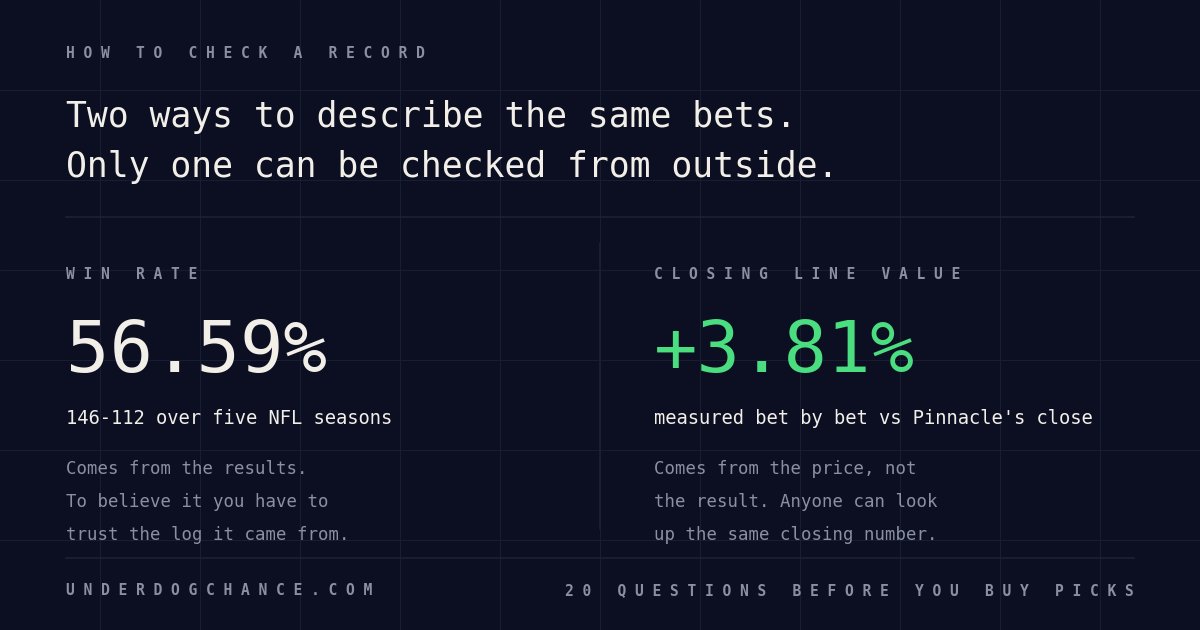
For my own NFL model I publish the record and the price test side by side: 146-112 across five seasons, 56.59%, with closing line value of +3.81% on one season and +4.25% on the 2025/26 snapshot, measured bet by bet against Pinnacle's close. The win rate is the part people quote. The closing line value is the part that can be checked by someone who does not trust me.
So when a seller shows you a win rate and nothing else, you are not looking at proof. You are looking at the one number that is easiest to produce and hardest to verify. Asking for the closing line comparison instead takes one message, and the reply tells you most of what you need to know.
What are the red flags that should end the conversation?
Any guarantee of winning is the end of the conversation. Nobody can guarantee the outcome of a single game, and a person who says otherwise has told you how they think about you.
The others worth walking away from:
- A long-run win rate claimed above roughly 60% on point spreads or totals. Real edges in these markets are small and slow.
- A record with no losing bets shown, or one that begins on a date that happens to follow a bad run.
- Units with no bankroll attached. Fifty units means nothing until you know what a unit was.
- Pressure to act in the next ten minutes. Price moves are real, but urgency is also the oldest sales tool there is.
- Insider information as the pitch. If it were real it would be illegal to act on, and it is almost never real.
- No answer at all to question 3. If they will not tell you where a bet was graded, the record is a story.
None of this means everyone selling picks is dishonest. It means the honest ones can answer plainly, so the questions cost you nothing and sort the field fast.
Is buying picks ever worth the money?
There is one case where it is worth it, and it is not the one people buy for. It is worth it when you use the service to learn how someone prices games, not to place their bets.
If a seller publishes their fair price for a game before the market moves, tells you why their number differs from the bookmaker's, and you can follow that reasoning, you are buying a teacher. That has value, and after a season you can do part of it yourself.
If all you get is a side and a stake, you are renting a decision. The moment you stop paying you are back where you started, and you have learned nothing you can use on the next game. That is not a scam. It is just a poor trade for your money, and knowing which of the two you are being offered is what the 20 questions are for.
What should I do instead of buying picks?
Make your own number first, then look at the price. That is the whole method, and it is simpler than it sounds.
I started with baseball, and I learned it from video games on purpose, because I wanted a sport I had no feelings about. Every bettor I knew had a team, a player they rated too highly and a grudge against a coach. I wanted a market where none of that could reach me, so I picked one I only knew through numbers. That choice did more for my betting than any pick I could have bought.
The practical version for you looks like this. Pick one league. Build a simple probability for each game from a handful of stats you can actually get. Turn that probability into a price. Compare it with the bookmaker's price, and bet only when yours is better. If your number says a team should be -120 and the book has them at +105, that is a bet. If the book has them at -150, you pass, and passing is most of the job.
You can play with the numbers yourself before you build anything, with short interactive lessons on expected value, fair odds and closing line value. If you want the finished spreadsheets rather than a blank page, my betting models are the same simple, probability-based Google Sheets I use, one per sport. And if you want a fair price on a game in seconds while you are still learning to build one, the AI Betting Assistant does that part for you.
The difference between this and a picks subscription is what you own at the end. A pick expires when the game kicks off. A number you can make yourself works on every game after it.
Questions people ask me about buying picks
Are paid sports picks profitable?
Most are not, and the ones that are rarely stay that way for long. To profit at a standard -110 price (1.91 decimal) you need to win more than 52.38% of your bets, and that is before the cost of the subscription. Add a monthly fee and the win rate you need climbs again, sometimes above 55%, which is very hard to hold over a season. Some services do clear that bar. The problem is that you cannot tell which ones from the outside without the record and price checks above, and by the time you have enough of your own results to judge, you have already paid for a year.
How much should sports picks cost?
There is no fair market price, which is itself the problem. Services run from free to several hundred dollars a month, and the price tells you nothing about the quality, because the seller sets it based on what people will pay rather than on what the edge is worth. A more useful question than the price is the ratio: what percentage of your bankroll is the yearly fee? If a service costs 20% of your bankroll per year, it has to beat the market by 20% before you are even. Very few edges in sports betting are that large.
How can I check a handicapper's record myself?
Take 20 of their posted bets, look up the closing price for each one, and compare it with the price they said they took. You do not need every bet and you do not need their spreadsheet. If most of their bets closed at a shorter price than they got, they are consistently ahead of the market and the record is likely real. If most closed longer, they were behind the market and any profit in the record is probably luck. This takes about an hour, costs nothing, and is far more informative than reading testimonials.
What win rate do I need to break even at -110?
You need 52.38%. At -110 (1.91 in decimal) you risk 110 to win 100, so out of 210 units staked across two bets you have to win 110 to get back to zero. That is 52.38%, and it is the single most useful number in betting because it sets the bar for everything else. A bettor at 53% is genuinely profitable. A bettor at 51% is losing money slowly while feeling like they are winning. The gap between those two is small enough that a season of results cannot tell them apart, which is why the price test matters more than the win rate.
Are free picks better than paid ones?
They are the same product at a different price, and both have a cost. Free picks are usually there to move you toward a bookmaker sign-up that pays the person posting them, so the incentive is volume rather than accuracy. Paid picks at least align the seller with keeping you subscribed, which requires some level of performance. Neither one leaves you with a method. If you are going to follow someone for free, follow the ones who publish their reasoning and their fair price, because you can learn from that even when the bet loses.
Can I use AI instead of a picks service?
You can use it for the parts that are arithmetic, and you should be careful with the rest. Removing the bookmaker's margin from a price, converting between American and decimal odds, comparing your number with the market, checking your stake against your bankroll: all of that is work a tool does faster and more accurately than you do. What general AI tools are poor at is knowing which stats matter for a sport and whether the data they were given is current. That judgement is still yours, and the 20 questions above apply to an AI answer just as much as to a person selling you a pick.
Where to go from here
If you want the shortest path from following picks to pricing your own bets, that is what The Ultimate Modern Bettor's Toolkit is for. It is $27, it includes the base model spreadsheet, the analytical thinking framework behind it and the walkthrough that shows you how to use both, and it comes with a 30-day money-back guarantee. If it does not change how you look at a price, you ask for your money back and keep going as you were.
Get The Ultimate Modern Bettor's Toolkit for $27MB built Underdog Chance around one idea: make your own number first, then bet only when the price beats it. Over the last 20+ years his simple, probability-based Google Sheets models have helped thousands of bettors stop following picks and start pricing bets for themselves.